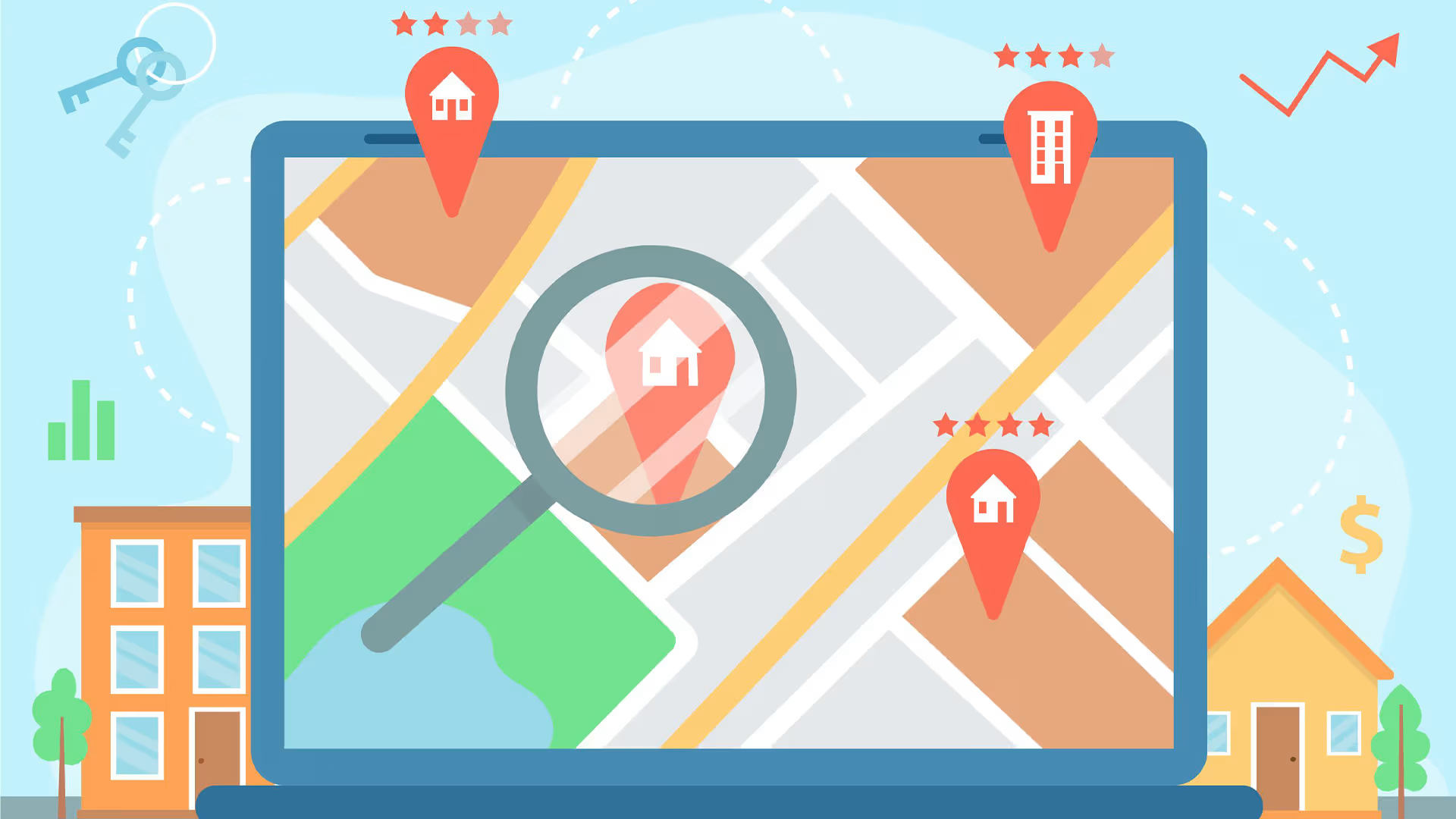
In short: Local SEO ensures that your business appears at the top of Google Maps and local search when people in Frankfurt and the surrounding area search for what you offer. The key levers are a complete Google Business Profile, consistent business data, location-relevant content, active reviews, and local backlinks. Optimize these factors consistently and you gain lasting visibility — without paid advertising.
Every time someone in Frankfurt searches "physiotherapist near me," "tax advisor Sachsenhausen," or "café Bornheim," Google makes a decision: which three businesses appear at the top of the Local Pack? That decision happens in milliseconds — and it's based on signals you can actively control. This guide shows you exactly what those signals are and how to use them.
What Is Local SEO — and How Does It Differ from Regular Search Optimization?
Standard SEO aims to rank in organic search for specific terms — regardless of where the searcher is located. Local SEO is more focused: it optimizes your visibility for people searching for you within a specific geographic area.
Google displays two distinct areas here. The Local Pack — the map box with three listings — appears directly below paid ads when Google detects local intent. Below that come the classic organic results. Effective local SEO work targets both areas simultaneously. The Local Pack dominates the visible area on smartphones, where the majority of local searches happen.
Google evaluates local listings based on three main factors: Relevance (does the business match the search query?), Distance (how far is the location from the searcher?), and Prominence (how credible, active, and recognized is the business?). The first two factors are partly outside your control — Prominence is what you can and must actively build.
For Frankfurt SMEs in densely populated sectors — doctors, lawyers, tradespeople, restaurants, boutiques — position in the Local Pack is literally the difference between a full calendar and an empty one. In an economically active region like Frankfurt and the Rhine-Main area, where businesses from Frankfurt, Offenbach, Bad Homburg, Hanau, Wiesbaden, and Darmstadt often share the same customer base, local visibility determines revenue on a daily basis.
Your Google Business Profile: The Foundation of Every Local SEO Strategy
No other lever has more direct influence on your Local Pack ranking than your Google Business Profile (formerly Google My Business). It's the data sheet Google maintains about your business — and one you can populate and maintain yourself.
The Key Components of a Strong Profile
- Name, Address, Phone number (NAP): Enter these exactly as they appear on your website and in every other directory. Discrepancies confuse Google.
- Primary category: Choose the most precise applicable category. Being categorized as "Dentist" ranks better for dental searches than "Doctor."
- Secondary categories: Up to nine additional categories allowed. Use them meaningfully, don't overstuff.
- Description: 750 characters, including primary keywords and a clear value proposition. No marketing fluff.
- Opening hours: Complete and current. Incorrect hours damage trust.
- Photos: At least 10 high-quality images — exterior, interior, team, products or services. Profiles with more photos get clicked more often.
- Posts (Google Posts): Regular short updates on offers, news, or events keep the profile active.
- Q&A section: Add and answer frequently asked questions yourself — this fills an often-overlooked profile section that's valuable for both users and Google.
The profile is the first touchpoint in local search. It appears before users ever click through to your website. An incomplete or outdated profile is a missed opportunity — and in many industries, the sole difference between position 1 and position 7 in the Local Pack.
A complete checklist of all 12 optimization points is in our Google Business Profile Optimization post.
NAP Consistency: Why Uniform Business Data Is Critical
NAP stands for Name, Address, Phone — and NAP consistency means: these three pieces of information must be identical everywhere on the internet. On Google, in local directories (Yellow Pages, Yelp, Das Örtliche, Branchenbuch.de), on your website, in social networks, and in industry registers.
Why does this matter so much? Google gathers information about your business from many sources and cross-references them. Discrepancies — even minor ones like "St." vs. "Street," an old phone number, or a slightly different business name — raise doubts about the reliability of your data. Doubt costs ranking.
Beyond this, citations — mentions of your business name with address and phone number on other websites — count as their own local SEO signal. The more consistent citations, the stronger the trust signal to Google. Inconsistent citations cancel each other out.
The process runs in three steps:
- Audit: Compile all existing mentions of your business on the web — Google, key directories, local industry portals. Tools like BrightLocal help with this.
- Correction: Fix divergent entries. Update outdated listings or flag them for removal.
- Maintenance: When address or phone number changes, update all sources immediately. Never only update Google and forget the rest.
This step sounds unglamorous but has a measurable effect — especially for businesses that have accumulated listings across many platforms over the years. We regularly see Frankfurt businesses with three different addresses and two different phone numbers on the web, wondering why they don't rank.
Local Keywords: How to Find and Use the Right Search Terms
Local keywords connect a service to a place. "Tax advisor Frankfurt," "hairdresser Sachsenhausen," "electrician Offenbach" — these are typical local searches you want to be found for. Not knowing these terms and not using them systematically means staying invisible.
How to Research Local Keywords
- Google Suggest: Type your service into Google search and see which location suggestions appear. These are real searches from real users.
- "Related searches": At the bottom of every Google results page, Google shows related search terms — often including local variants and neighborhood names.
- Competitor analysis: Look at which terms well-ranking competitors optimize their pages for — meta titles, H1 headings, body copy.
- Google Search Console: If your website already exists, Search Console shows which queries you're already appearing for. Often there are local queries where you're not yet optimally positioned.
- Include neighborhoods and surrounding towns: A Frankfurt-based business that also serves clients from Offenbach, Hanau, or Bad Homburg should create dedicated pages or sections for those locations.
Where the Keywords Belong
- Page title (H1) and at least one H2 heading
- Meta title and meta description for every page
- First 100 words of page copy
- File names and alt text for photos
- URL structure where possible
- Google Business Profile description
- Google Posts and answers to user questions
Important: use keywords naturally. Text that's visibly written for the algorithm looks untrustworthy and converts poorly — double damage. Google detects keyword stuffing and penalizes it.
Reviews: The Strongest Trust Signal in Local Search
Google reviews directly influence Local Pack rankings and influence the searcher's click decision even more directly. A business with 4.8 stars and 120 reviews gets clicked — one showing 3.9 stars with 12 reviews doesn't. Reviews are today's equivalent of word-of-mouth referrals — just at digital scale and visible to everyone.
How to Systematically Win More Reviews
- Ask actively. The best moment: immediately after a positive experience. Ask in person and send a direct link to the review form.
- Make it easy. Create a short link (via Google Business Profile → "Get more reviews" link) and embed it in email signatures, on receipts, or on your website.
- Respond to all reviews. Positive (short, personal, not templated) and negative (measured, solution-focused, never defensive). Responses show Google and searchers that the profile is actively managed.
- No fake reviews. Google detects and penalizes these — and a single controversy destroys trust that genuine reviews took months to build.
- Time it right: After a successfully completed job, after a positive feedback call, after resolving an issue. The right moment makes the difference.
Responding professionally to negative reviews is more important than many realize. A measured, constructive response to a bad review demonstrates to potential customers that you handle criticism well — and often reads as more trustworthy than a profile with nothing but five-star ratings.
For businesses that want to automate this process, we offer a review management system as part of our AI automation solutions — the system prompts at the right moment and follows up with customers automatically.
Local Backlinks: Building Trust Signals from Your Region
Backlinks — links from other websites to yours — are a classic SEO signal. Locally, links from regionally relevant sources carry particular weight: city portals, local newspapers, trade associations, the Frankfurt Chamber of Commerce (IHK Frankfurt), local blogs, and partner businesses.
Where Local Backlinks Come From
| Source | Why it's valuable |
|---|---|
| IHK Frankfurt / business associations | High trust, strong domain authority |
| Local online news (Frankfurter Rundschau, FAZ.NET) | Reach and regional relevance |
| City portals and industry directories | Directly location-relevant for Google's local algorithm |
| Partner businesses and suppliers | Easy to obtain, mutually beneficial |
| Local blogs and influencers | Authenticity and niche relevance |
| Event websites | Time-bound visibility, useful mentions |
| Universities and educational institutions | Very high domain authority, hard to obtain |
Local backlinks rarely appear on their own. Active measures help: offering guest posts to local portals, issuing press releases for real news, attending local networking events, and making yourself citable as an expert. Anyone who's a member of the IHK Frankfurt, a retail association, or a trade body should absolutely use and keep current their directory listing there.
Quality beats quantity. A single link from the Frankfurter Rundschau or the IHK Frankfurt portal is worth more than a hundred links from unknown, low-quality directories.
On-Page Optimization for Local Search: What Your Website Needs to Deliver
A well-maintained website significantly amplifies every other local SEO measure. Your Google Business Profile attracts users — your website converts them. A perfect profile with a technically poor or unconvincing website wastes the attention you've worked hard to earn.
Location-Relevant Content
Every page on your website should make the connection to your location clear. That doesn't mean forcing "Frankfurt" into every sentence — but service pages should include the location in the title, body copy, and meta description. Businesses serving multiple neighborhoods or nearby cities (Offenbach, Bad Homburg, Hanau, Wiesbaden, Darmstadt) can create dedicated pages or sections for each — known as location pages.
Location pages for every area you serve are particularly effective for tradespeople, mobile service providers, or businesses with multiple locations. Each page should contain unique, genuinely useful content — don't just swap out the city name.
Technical Foundation
- Page speed: Google measures Core Web Vitals. A slow website ranks lower and loses visitors before they convert. Aim for main content loading in under 2.5 seconds.
- Mobile-first: The majority of local searches happen on smartphones. The website must work perfectly on small screens — not just readable, but genuinely user-friendly.
- SSL certificate: HTTPS is non-negotiable today. Unencrypted pages lose trust and ranking.
- Schema markup:
LocalBusinessstructured data helps Google correctly assign your address, opening hours, and category — and can appear as Rich Snippets in search results.
What a technically sound, fast-loading website looks like is covered on our web design & development page. The connection between website quality and SEO performance is more direct than many SMEs realize.
360° Tours as a Local SEO Amplifier
An often-overlooked lever in local SEO: virtual 360° tours linked directly to your Google Business Profile. They increase the interaction rate with your profile, extend dwell time, and make the listing more complete — all signals Google factors into its local ranking.
The mechanism is simple: someone who opens a virtual tour spends significantly more time with your profile. More time means a stronger engagement signal, which means better ranking. Your profile is also more complete than competitors who don't have this element.
How 360° tours concretely improve local ranking is explained in detail in our article 360° Tours on Google Maps. In Frankfurt especially, where many sectors are crowded, the 360° tour is a differentiator that very few competitors use.
Measuring Local SEO: How to Track Progress
When you invest, you want to know whether it's working. The most important metrics for local SEO:
- Google Business Profile Insights: How many users have seen your profile, clicked it, called you, or requested directions? Google provides this data directly in the profile — free and detailed.
- Ranking positions: Tools like Google Search Console, Whitespark, or BrightLocal show which local keywords you're ranking for and where. Important: rankings are location-dependent — your position as seen from Frankfurt city center may differ from your position as seen from Sachsenhausen.
- Organic search traffic: Trackable in Google Analytics or Search Console — is the share of local search queries and overall organic traffic growing?
- Conversion tracking: Are searches resulting in calls, appointment bookings, or contact form submissions? That's the real measure of success. Call tracking can be set up in Google Analytics and the profile.
Measure monthly and adjust accordingly. Local SEO isn't a one-time project — it's an ongoing process. Optimize for six months then stop, and results will slowly slip back as competitors keep going.
How Does Local SEO Differ Across Industries?
The core principle is universal; the emphasis shifts by sector. A few concrete examples:
- Hospitality: Photos and reviews are especially decisive. Add a menu to the profile. Use Google Posts for specials and events. Embed a reservation link.
- Medical and dental practices: Trust is paramount. Complete profile, many positive reviews, ideally a 360° practice tour. Link appointment booking directly. Observe GDPR requirements on contact forms.
- Tradespeople: Define service area clearly. Create location pages for neighboring cities (Offenbach, Hanau, Bad Homburg). Before-and-after photos demonstrate quality convincingly.
- Retail: Add products to the profile. Keep inventory current where possible. Maintain store opening hours especially carefully — incorrect hours on public holidays generate instant negative reviews.
- Lawyers & tax advisors: Communicate specialization clearly. Practice photos and partner profiles reinforce credibility. In-depth content and explanatory articles build authority.
- Gyms & wellness: 360° tours and equipment photos persuade before the trial session. Use Google Posts for class schedules and promotions.
What all industries share: active profile management, genuine customer reviews, and a clean, fast website are the baseline. Everything else is sector-specific fine-tuning.
What Does Local SEO Cost — and When Does It Pay Off?
Local SEO isn't free, even when many of the platforms themselves cost nothing — the work behind them does. The question isn't whether you can afford local SEO; it's whether you can afford to ignore it.
A one-time local SEO setup at Okapi Digital starts from €790. This includes full profile optimization, NAP audit, keyword research, and technical baseline optimization of your website. For ongoing management — monthly optimization, content, reporting — packages start from €399/month.
Given that a single new regular customer often exceeds this investment within the first month in many industries, the ROI is typically clear. Local SEO differs from advertising in that it compounds: the effect grows over time without paying per click.
Conclusion
Local SEO for Frankfurt and the Rhine-Main region isn't secret knowledge — it's consistent work on the right levers. A complete, active Google Business Profile, consistent NAP data across the web, location-relevant website content, an active review strategy, and regional backlinks: build these five pillars and you gain lasting visibility — in Frankfurt, Offenbach, Bad Homburg, Hanau, Wiesbaden, and Darmstadt.
The good news: in most industries, the field isn't so saturated that you'd need extraordinary resources. Starting now builds an advantage that compounds over time — and that competitors who wait will find increasingly hard to close.
Want to know where your business stands in local rankings today and which measures would have the biggest impact? Book a free intro call. We'll analyze your Google profile and local visibility — and give you a clear roadmap. Our SEO packages are here.